
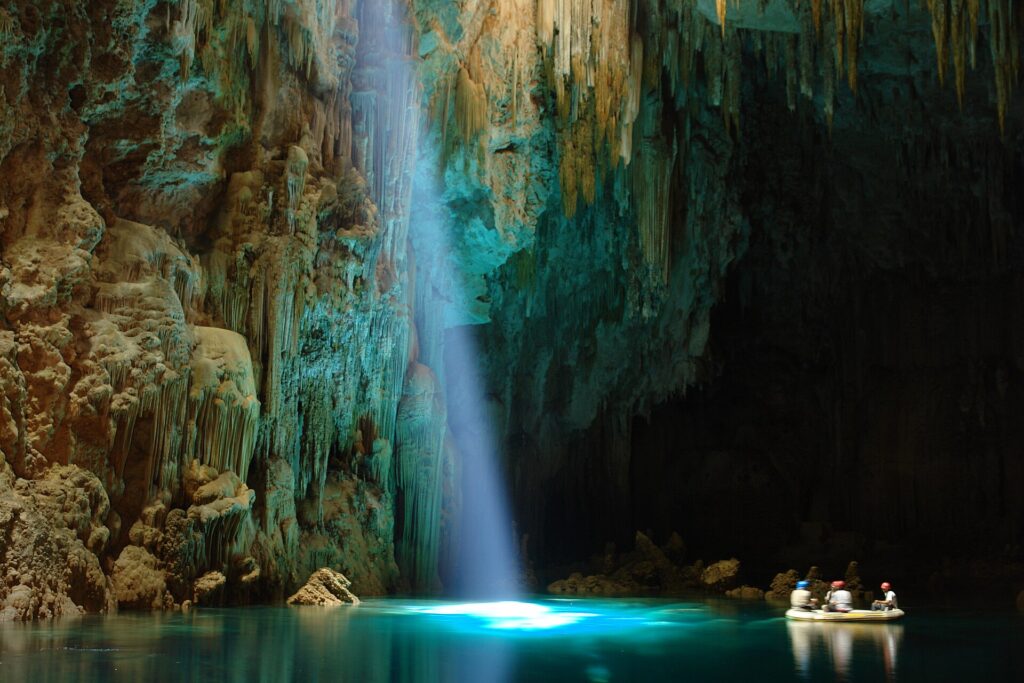
Bonito did not become a world reference in ecotourism by accident. It was the first town in Brazil to control access to its natural attractions with a daily visitor cap, a mandatory local guide and a voucher system that makes overcrowding impossible. The result is in the rivers with absurd visibility, the blue caves and the macaws circling over sinkholes. This guide explains how the town works, what the tours cost in 2026 and how to plan the trip without falling into the usual traps.
Where it is and how to get there
Bonito sits in the Serra da Bodoquena, in south-western Mato Grosso do Sul. There are limited direct flights to the regional airport; the common route is to fly into Campo Grande and cover the remaining 300 km by transfer or rental car (about 4 hours; shared transfers from R$ 100). A car helps, because most attractions are on private land spread around the town.
How Bonito works (read this before booking)
Three rules change everything. (1) Every tour is sold as a single voucher, at a fixed price that is identical in any agency — do not waste time hunting for a discount. (2) Attractions have a daily visitor cap, so in high season the best time slots sell out weeks ahead. (3) Almost everything is on private property with a mandatory local guide. Bureaucracy? It is conservation — and it is exactly why the rivers are still transparent after 30 years of tourism.
The essential tours and what they cost (2026)
| Tour | Price (high season) | What it is |
|---|---|---|
| Snorkeling the Rio da Prata | ~R$ 570 | The most famous float in Brazil, with shoals of dourado and piraputanga |
| Snorkeling the Rio Sucuri | ~R$ 440 | One of the clearest rivers in the world, with a blue spring |
| Gruta do Lago Azul | ~R$ 180 | A cave with a cobalt-blue underground lake, the town’s postcard |
| Buraco das Araras | ~R$ 185 | A giant sinkhole with red macaws circling inside it |
| Boca da Onça | ~R$ 700 | The tallest waterfall in Mato Grosso do Sul (156 m), on a trail with dozens of falls |
| Abismo Anhumas | from ~R$ 800 | A 72 m rappel into a cave, followed by snorkeling in an underground lake |
| Balneário Municipal | ~R$ 98 | The town’s public river beach, easy for all ages |
Torn between the two rivers? The honest, side-by-side answer is in snorkeling in Bonito: Rio da Prata or Rio Sucuri.
When to go
The water is at its clearest in the dry season (May to September) — August and September usually deliver the best visibility of the year. From December to March the rains fill the waterfalls but can cloud the rivers for a few days. To pay less and avoid the crowds, aim for May, June (outside public holidays), August or September, on weekdays.
What the trip costs
Guesthouses run from R$ 140 (hostel) to R$ 600+ (comfort) a night. Meals sit between R$ 45 and R$ 130 — try the traditional sopa paraguaia and pintado à urucum. With two snorkeling trips, the cave and Buraco das Araras over 4-5 days, a budget-minded couple spends from about R$ 4,000 per person including flights; with premium tours such as Anhumas and Boca da Onça, plan for R$ 6,000-9,000. The good news for an ecotourist: every real paid through the vouchers funds the monitoring and the properties that protect the springs.
Quick tips
- In high season, book the tours BEFORE the guesthouse — the tours are what sell out.
- Do not touch the riverbed: one step lifts sediment and ruins the visibility for everyone behind you.
- Fixed prices mean the agency competes on service, not on price — choose the one that answers you well.
- The classic booking traps have a guide of their own: 7 common mistakes people make in Bonito.
Combining the trip: the South Pantanal is about 300 km from Campo Grande and pairs with Bonito for the perfect week in Mato Grosso do Sul — crystal-clear water and safari on the same flight. Bonito also pairs with other nature destinations across the country — explore our list of ecotourism destinations in the Brazilian northeast for the next trip.
🥾 Who is it for?
Effort: light — the floats are contemplative and the current does the work. Children: most rivers accept ages 5-6 and up with a life jacket and wetsuit; river beaches such as the Balneário Municipal work for every age. Older travelers and people with reduced mobility: Bonito is a national reference for accessibility in ecotourism — several attractions have adapted infrastructure; tell the agency in advance so they build the right itinerary.