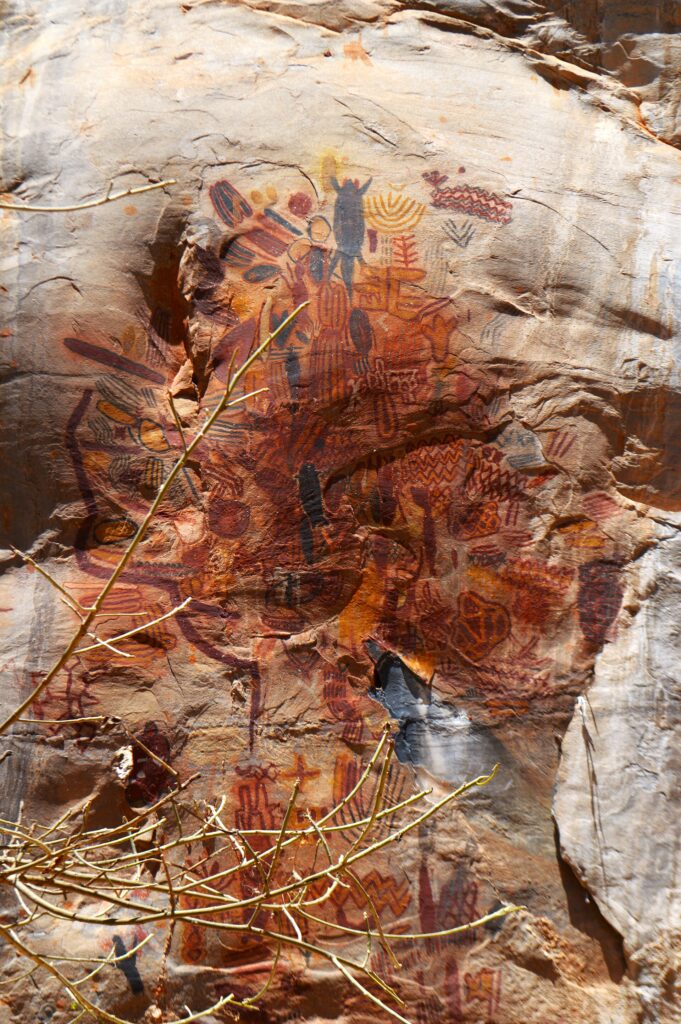
Before it was a park, the Peruaçu valley was home — for thousands of years. The canyon’s walls and rock shelters hold one of the richest ensembles of rock art in Brazil: red, yellow and black panels of geometric patterns, animals, plants and figures that have intrigued archaeologists since the 1970s — and that helped stamp the UNESCO World Heritage title.
Lapa dos Desenhos
The high point of the archaeological route: a broad shelter with the largest concentration of paintings in the region — overlapping panels from different eras, like a collective mural painted across centuries. Fish, deer, geometric weaves and suns share the rock with a view over the valley — the artists knew how to choose a studio.
Lapa do Boquete
Here the archaeology gains depth: excavations revealed nearly continuous human occupation for more than 10,000 years — remains of fires, burials, ceramics and traces of early agriculture that make this shelter one of the most important sites in Brazil’s interior. The guide tells the discoveries layer by layer; living history underfoot.
How to visit with respect
- Only with a credentialed guide and on the marked paths.
- Do not touch the panels — sweat erases what time preserved.
- Photos without flash; drones only with park authorization.
- Do not pick up “souvenirs” from the ground: even a shard can be a museum piece.
Building the route
The perfect one-day combo: Janelão in the morning (skylight light) and Lapa dos Desenhos in the afternoon; on day two, Boquete + Arco do André. If you have seen our coverage of Serra da Capivara and Catimbau, you will notice the differences in style — rock-art Brazil is an archipelago of artistic schools, and the Peruaçu is one of its most colorful islands.
🥾 Who is it for?
Effort: light to moderate — short trails with rocky stretches and cerrado heat. Children: from age 6-7 — the drawings are a magnet for young curiosity. Seniors and reduced mobility: among the park’s routes, the rock-art sites are the most accessible (shorter walks than the great caves) — tell your guide to prioritize the easy-access shelters.