
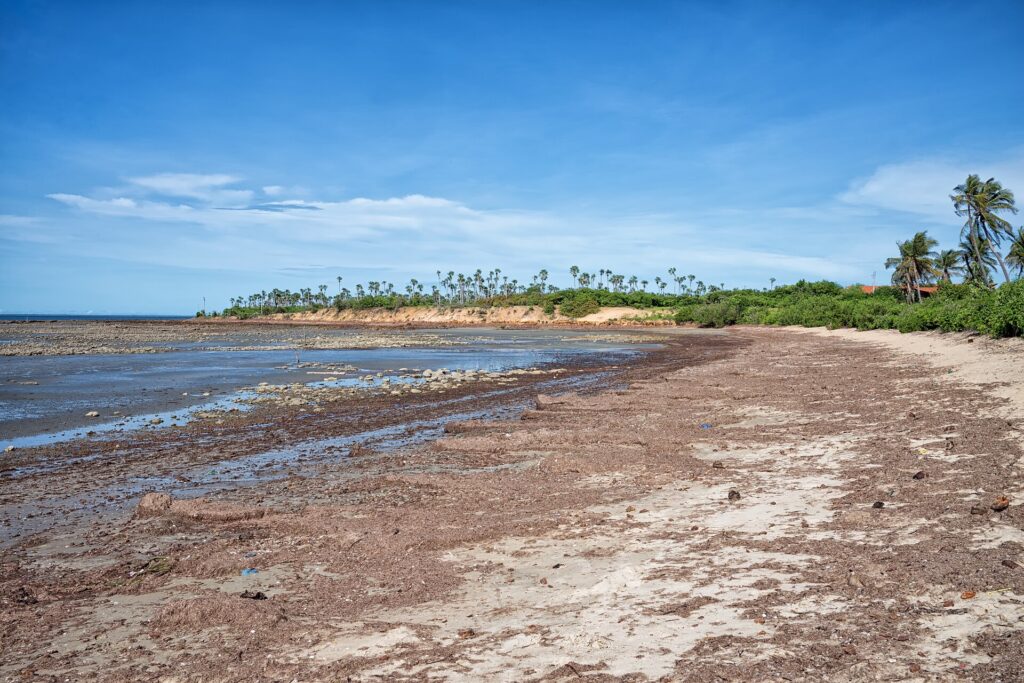
Brazil’s shortest coastline holds two of the country’s rarest animals: the West Indian manatee — the most endangered aquatic mammal in Brazil, with only a few hundred individuals — and healthy populations of seahorses in the mangroves. Cajueiro da Praia (PI), the municipality of Barra Grande, is an official sanctuary for both, and the observation trips are among the most delicate and moving wildlife experiences in the Northeast.
The seahorse trip
In a paddled canoe (silence is part of the method), you glide through the mangrove igarapés while the local guide — usually a fisherman from the community — spots the seahorses clinging to the roots (R$ 60-100, about 2h). The rule changed in recent years and changed for the better: observation in the water, no on-board aquarium, no handling — the animal does not leave home for your photograph. Bring sharp eyes: spotting a camouflaged seahorse yourself is addictive.
The gentle giant of the Timonha
The estuaries of the Timonha and Ubatuba rivers, on the Piauí-Ceará border, shelter one of the last healthy populations of the West Indian manatee. Boat trips (R$ 100-200, half a day) run the channels with a real chance of seeing a snout come up to breathe — always at a distance, engine down, never surrounding the animal. There is no “guaranteed sighting” here, and that is how it should be: a manatee is not a theme-park attraction, it is a survivor being respected. Turtles, egrets and the monumental mangrove complete the trip in any case.
Why this visit matters
- Every trip pays a fisherman-guide — the same community that once saw the manatee as a competitor now defends it as heritage (and as a source of income).
- The APA Delta do Parnaíba and the local conservation work depend on conscious visitors to exist politically.
- Choose accredited guides, refuse any offer to “touch/feed”, and your visit becomes a vote for the species.
Combine it with the scarlet ibis fly-in in the neighboring delta and you will have, in two days, three of the most special wildlife encounters in Brazil — all within an hour’s drive of one another.
🥾 Who is it for?
Effort: easy — canoe and boat trips on calm estuary water. Children: from the age of 5; seeing a manatee and a seahorse up close is a living biology lesson. Older travelers and reduced mobility: very feasible — a seated, gentle activity; simple boarding with help from the guides.