
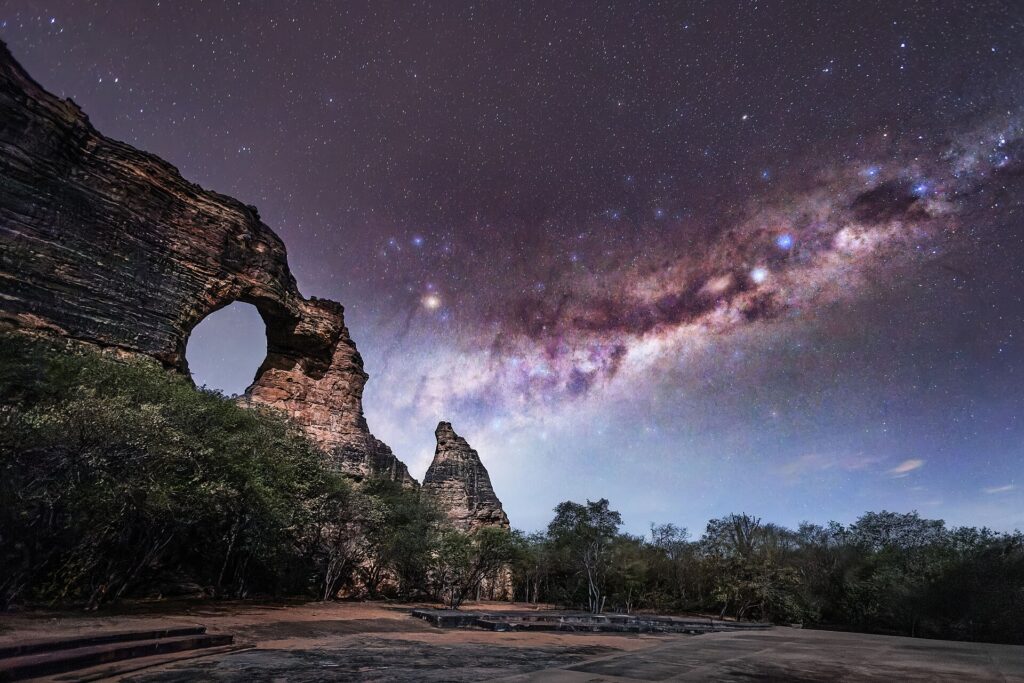
In south-eastern Piauí there is a place where ecotourism and archaeology are the same trail: the Serra da Capivara National Park, a UNESCO World Heritage site, holds the largest concentration of rock art in the Americas — tens of thousands of figures up to 12,000 years old (and contested traces far older) spread across walls of red caatinga. Better still: with visitor facilities that shame far more famous parks. Here is the complete guide.
Getting there and where to stay
The base is São Raimundo Nonato, 28 km from the main entrance. Regional flights reach the local airport (Serra da Capivara) on set days; the reliable alternative is to fly into Petrolina (PE) and drive 300 km. The town has guesthouses from R$ 100 to R$ 300 and a network of guides trained by the Fundação Museu do Homem Americano itself — probably the best-prepared guides in Brazilian ecotourism.
How the visit works
- Entry is free, but an accredited guide is compulsory (R$ 250-350 a day per vehicle) — and here that is a gift, not a cost: the guides turn stone into narrative.
- The park has 130+ open sites organized into circuits; good internal roads and impeccable walkways at the main canyons.
- The detail of the circuits and what the paintings mean: the rock art of the Serra da Capivara.
- Two museums complete (and explain) everything: the Museu do Homem Americano (~R$ 30) and the award-winning Museu da Natureza (~R$ 40) — include both.
When to go and what it costs
| Item | 2026 reference |
|---|---|
| Park entry | Free |
| Accredited guide (per day) | R$ 250 – R$ 350 per vehicle |
| Museums (Homem Americano + Natureza) | ~R$ 70 |
| Guesthouses | R$ 100 – R$ 300 a night |
| 3 days per person (excluding flights) | R$ 900 – R$ 1,600 |
Why the Capivara matters so much
This park rewrote the prehistory of the Americas and proved that the caatinga — the only exclusively Brazilian biome — can be spectacular and economically alive through tourism. Every visit sustains a local network of guides, ceramicists and guesthouses that has made São Raimundo Nonato a rare case of a backlands town with a future anchored in conservation. Plan your days with the 2-day itinerary, and be warned: the sunset at the Boqueirão da Pedra Furada is worth the trip on its own.
🥾 Who is it for?
Effort: light to moderate — the park has exemplary walkways and facilities; the circuits are done by car with short walks. Children: excellent from age 6 — the paintings and the canyons look like a film set. Older travelers and people with reduced mobility: a national reference for accessibility in parks: walkways, ramps and adapted viewpoints on the main circuit (Pedra Furada), including conditions for wheelchair users on that circuit; beyond it the terrain is rough — plan the sections with your local guide.