
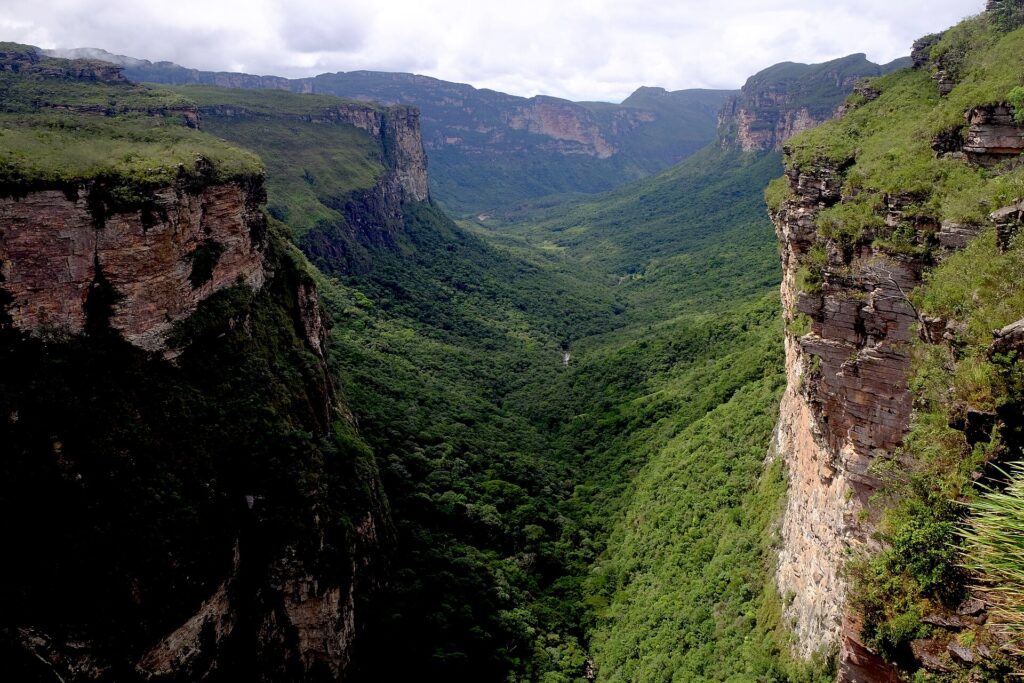
There is a valley in the Chapada Diamantina where cars do not go, the power is solar, dinner is picked in the back garden and the “guesthouses” are the homes of families who have lived there for generations. Crossing it on foot — 3, 4 or 5 days between 300-meter walls — is what many consider the best trek in Brazil. This guide explains how to do the Vale do Pati properly. The overall picture of the region is in the Chapada Diamantina guide.
How it works
The Pati is walked house to house: the valley natives — families who stayed on after the mining exodus — host trekkers in simple rooms, with hot showers, farm coffee and dinners that become legend among travelers (the godó de banana is a rite of passage). You walk 4 to 7 hours a day with a light pack, past viewpoints such as the Cachoeirão (an amphitheatre of cliffs with a 270 m fall) and the Morro do Castelo (with its cave running right through the mountain).
The classic routes
| Route | Days | Who it is for |
|---|---|---|
| Crossing Capão → Andaraí | 4-5 | The complete one: down into the valley, up to the Cachoeirão, out via Igatu or Andaraí |
| Short circuit (in and out via Capão) | 3 | The essence of the valley with one day less on the legs |
| Pati + Castelo + Fumacinha (expedition) | 5-6 | Veterans with stamina and sound knees |
Preparation: the Pati charges
- Fitness: climbs of 500-800 m of elevation gain with a pack. You do not need to be an athlete; you do need to have walked before. Two months of stairs and walking will do it.
- Pack: 8-10 kg maximum — swimwear, a second change of clothes, a rain jacket, a flashlight and CASH (there is no signal and no card machine in the valley).
- Booking: the native houses have a counted number of beds — in high season (June to September and public holidays), lock in guide and accommodation weeks ahead.
- Season: April to October is the safe window; in the rains the valley rivers rise and crossings close.
Why the Pati matters
Trekking tourism saved the valley: when the mining died, the families who stayed found in hosting the income that keeps the Pati inhabited, cultivated and protected — the perfect example of ecotourism sustaining the people who sustain the landscape. Every night slept in a native house is a vote for the best trek in Brazil to keep existing. And do not rush to leave: the “extra” day at the Cachoeirão is always the best decision of the crossing.
🥾 Who is it for?
Effort: intense — 3 to 5 days of crossing with a pack, hard climbs and nights in native houses; one of the great treks in Brazil. Children: not recommended before age 14, and only with real trail experience. Older travelers and people with reduced mobility: only for ecotourists aged 60+ with excellent fitness and a trekking history; it is not suitable for mobility limitations.