
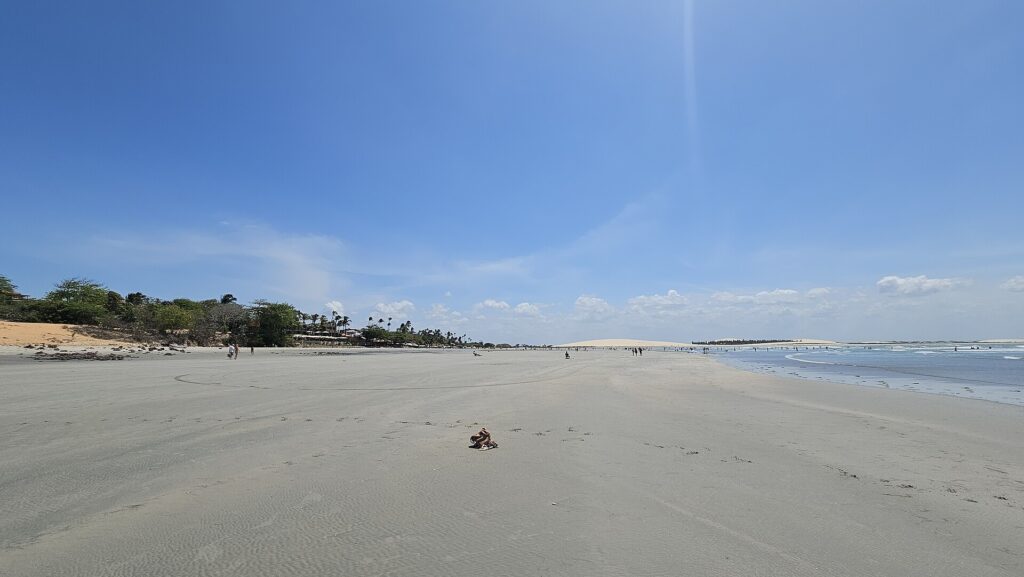
Picture a sand village where cars barely go, where the sunset is applauded from the top of a dune and crystal-clear lagoons appear in the middle of nowhere. That is Jericoacoara, on the western coast of Ceará — one of the most wanted ecotourism destinations in Brazil. This complete, up-to-date guide covers how to get there, the best time to visit, what to do, what it costs and every practical tip for making the most of “Jeri”.
Where is Jericoacoara?
Jericoacoara is a village in the municipality of Jijoca de Jericoacoara, about 300 km from Fortaleza, the capital of Ceará. The village sits inside the Jericoacoara National Park, which explains its preserved charm: sand streets, no conventional street lighting and nature on every side. It is the perfect setting for ecotourism — and it is no accident that Jeri has been named one of the most beautiful beaches in the world.
How to get to Jericoacoara
By air
The fastest way is to fly into Jericoacoara Airport (JJD), in Cruz, about 30 km from the village. From there you finish the journey by 4×4 or accredited transfer. The more common alternative is to fly into Fortaleza (FOR) — usually with more flight options — with return fares in the R$ 900 to R$ 1,500 range, and continue overland; compare the total cost (airfare plus the overland leg) of both routes for your dates.
From Fortaleza to the village
From Fortaleza the journey takes 4 to 5 hours. The most used options are the shared transfer (from R$ 100 to R$ 150 each way) and the private transfer, more comfortable for families. Anyone driving or arriving by bus travels to Jijoca and continues in the traditional open-sided jardineira trucks or a 4×4, because the final stretch runs over dunes and soft sand — ordinary cars do not make it.
When to go: the best time to visit Jeri
Jericoacoara is a sunny destination all year, but each season delivers a different experience for an ecotourist:
- July to December: dry season, blue skies and strong winds — paradise for kitesurfing and windsurfing. It is also high season.
- January to June: after the rains, the lagoons are full and even more beautiful. The best window for anyone whose priority is the Lagoa do Paraíso and the Lagoa Azul.
- March to May: the heaviest rainfall; lower prices, but some tours can be affected.
The Sustainable Tourism Fee: what it costs and how to pay
Every ecotourist has to pay the Sustainable Tourism Fee (Taxa de Turismo Sustentável, TTS) of Jijoca de Jericoacoara, which costs R$ 41.50 per person for stays of up to 10 days (R$ 4.15 per additional day). The money goes back into cleaning, environmental protection and the upkeep of the village — in other words, it is your ticket to keeping Jeri exactly as it is. Payment can be made online, on the official portal of the Jijoca de Jericoacoara city council, or at the entry points to the village. Exempt: children under 12, people aged 60 or over, people with disabilities (on proof), residents and local workers. It is worth paying online in advance to avoid lines on arrival. The Jericoacoara National Park itself does not currently charge admission. (TTS values and payment method confirmed on the city council’s official website; exemptions per the municipal decree cited in a current tourism source — checked in August 2026.)
What to do in Jericoacoara
Duna do Pôr do Sol (Sunset Dune)
The most famous ritual in Jeri: at the end of the afternoon, residents and ecotourists climb the big dune beside the village to watch the sun dive into the sea — and applaud it. Arrive at least 40 minutes early to get a good spot.
Pedra Furada
The postcard of Ceará, this stone arch carved by the sea is reached on a walk of about 3 km along the beach (at low tide) or by a trail over the hill — a contemplative outing that alone justifies the trip. Between June and July the sun lines up with the hole in the rock at dusk, a spectacle of its own for photographers.
Lagoa do Paraíso and Lagoa Azul
The famous freshwater lagoons in shades of turquoise sit on the road between Jeri and Jijoca. The Lagoa do Paraíso is known for its hammocks in the water and its bars and restaurants; the Lagoa Azul wins on tranquillity. In the first half of the year, with the lagoons full, the landscape is even more striking.
Buggy tour: east side and west side
The classic buggy tour splits into two routes. The east side is the calmer one and takes in the lagoons, the Árvore da Preguiça (the wind-sculpted “lazy tree”) and Pedra Furada seen from above. The west side is more adventurous: the dunes of Tatajuba, Mangue Seco and the fun esquibunda sand slide. A buggy for up to 4 people costs on average R$ 300 to R$ 600 for the day, depending on the route and the season. Hiring accredited local buggy drivers is the best call: you ride with someone who knows every dune, and your money stays with the local community.
Kitesurfing, windsurfing and other adventures
From July to December the steady winds turn the region into one of the best kitesurfing spots in the world, with schools for beginners at Praia da Malhada and nearby. Also worth doing: sandboarding on the dunes, a horse ride along the beach and the walk up to the Serrote, with a panoramic view over the village.
What a trip to Jericoacoara costs
| Item | Average price (per person) |
|---|---|
| Return flight to Fortaleza | R$ 900 to R$ 1,500 |
| Shared transfer (each way) | R$ 100 to R$ 150 |
| Sustainable Tourism Fee (up to 10 days) | R$ 41.50 |
| Guesthouse (per night, double) | R$ 150 to R$ 360 |
| Restaurant meal | R$ 60 to R$ 120 |
| Buggy tour (up to 4 people) | R$ 300 to R$ 600 per vehicle |
Adding it all up, a 5-day trip comes to an average of R$ 2,750 to R$ 5,100 per person, varying with the season, the standard of accommodation and the tours you choose. Most places accept cards and Pix, but bring some cash for tips and small purchases.
Where to stay in Jericoacoara
The village is small and easy to cover on foot. An ecotourist who wants convenience should stay near the Rua Principal or the Rua do Forró, the heart of the nightlife. For more quiet, the guesthouses around Praia da Malhada and the outer streets guarantee peaceful nights a few minutes from the buzz. Many guesthouses in the village belong to local families and follow sustainable practices — staying in one is living Jeri properly. Book well ahead in high season (July to January) and over long weekends: Jeri fills up.
Practical tips for the ecotourist
- Pay the Sustainable Tourism Fee online before traveling and keep the receipt.
- Bring sunscreen, a hat and a reusable water bottle — the sun is strong all year.
- Use accredited local agencies, guides and buggy drivers for the tours.
- On the trails and dunes of the national park, carry your rubbish back out and avoid stepping on the vegetation.
- Cash machines are scarce in the village; bring cash as well as a card.
- The mobile signal can be patchy — download offline maps before you arrive.
Frequently asked questions about Jericoacoara
How many days should I spend in Jericoacoara?
Four to five days is ideal: one to get to know the village and the Sunset Dune, one for the east-side tour, one for the west side, and at least one free day for the beach, the lagoons or watersports.
Is Jericoacoara expensive?
Jeri has options for a range of budgets, but it is among the pricier destinations in the Brazilian northeast. Traveling in the first half of the year (outside the school vacation) can save a lot on accommodation and transfers.
Do I need a car in Jericoacoara?
No. The village is explored on foot, and the tours around it are done in buggies, 4x4s or quad bikes with local drivers. Ordinary cars do not even reach the village.
Which airport is better: Jericoacoara or Fortaleza?
Jericoacoara airport (JJD) is the closest and most practical — it cuts the overland time and cost sharply — but tends to have fewer flights. Fortaleza (FOR) offers more options; which works out cheaper overall varies with the season and how far ahead you book, so compare both routes for your dates.
Read also: plan your trip to Jeri
- 4 days in Jericoacoara: a day-by-day itinerary
- What to pack for Jericoacoara: the ecotourist checklist
- Jericoacoara or Fernando de Noronha? The full comparison
- 10 ecotourism destinations in the Brazilian northeast
🥾 Who is it for?
Effort: light — buggy tours, dunes and lagoons ask for little beyond a willingness to walk on sand. Children: an excellent destination at any age; in the buggy, insist on a child seat or belt for the little ones. Older travelers: workable at an unhurried pace — the village is flat, but walking on soft sand is more tiring than on pavement; the buggy tours cut the walking down. People with reduced mobility: possible with support, favoring buggy transfers and short stretches; agree the limits with your driver in advance. Wheelchair users: take note — the village streets are soft sand with no paving, which makes wheeling very difficult; boarding a buggy requires an assisted transfer, and we could not find, in current sources, any adapted public infrastructure (boardwalks or beach wheelchairs) in the village. Ask your guesthouse about adapted rooms and support before booking (checked in August 2026).
💡 Golden tip: Jericoacoara is also the starting point of the Rota das Emoções, the epic 4×4-and-boat crossing that runs on through the Delta do Parnaíba to the Lençóis Maranhenses. If you can stretch the trip, it is one of the great journeys in Brazil.