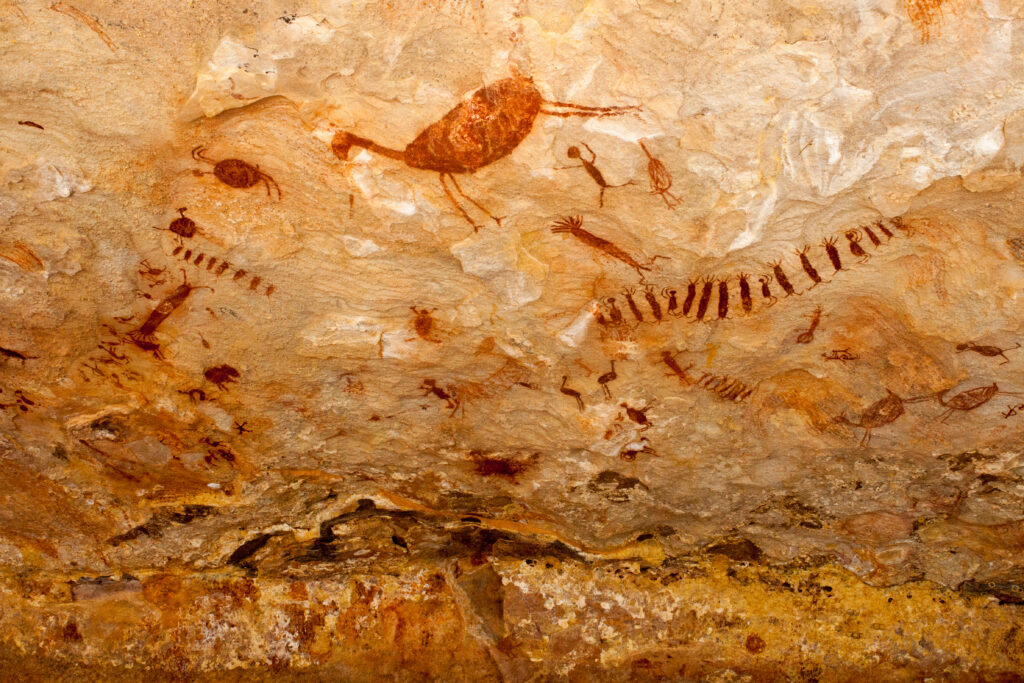
From a distance they look like red scribbles on the rock. Up close, with a guide narrating, they become cinema: group deer hunts, rituals around trees, dances, births, scenes archaeologists prefer not to explain out loud. The paintings of the Serra da Capivara are the record of thousands of years of people living in this backland — and learning to read them is the central experience of the park. The general logistics are in the complete guide; this is the soul of the visit.
What the paintings show
The so-called Nordeste Tradition dominates the walls: human and animal figures in movement — not static portraits, but ACTION. Rheas being chased, capybaras, extinct giant armadillos, collective scenes around trees (rituals? harvests?) and the enigmatic figures with raised arms. The paint: haematite ochre, blood, fat and plant gum — chemistry that has held to the rock for 12 millennia. Your guide will also show you the overlaps: generations painting over generations, a collective mural centuries deep.
The essential circuits
- Boqueirão da Pedra Furada — the emblematic site: an amphitheatre with a 100 m wall, hundreds of paintings and exquisite walkways. Late afternoon means golden light on the rock.
- Desfiladeiro da Capivara — a walk between narrow walls with panels at every bend; the most immersive circuit.
- Baixão das Andorinhas — a viewpoint over the red range and the fly-in of thousands of swallows at dusk (rainy season).
- Sítio do Meio — for the obsessed: traces that fuel the debate about when humans reached the Americas.
Rules for visiting a treasure
Do not touch the paintings (the oil on your skin degrades millennia-old pigment), no direct flash, drones only with authorization, and stay on the walkways — every centimeter beyond them may be intact archaeological ground. And the golden emotional rule: let the guide tell the stories BEFORE you photograph. You take the photo home; you also take the shiver of understanding what you are seeing.
Complete the context at the museums (Homem Americano and Natureza) and organize the days with the 2-day Capivara itinerary.
🥾 Who is it for?
Effort: light — the main painting sites have walkways and short access. Children: from ages 5-6; the painted scenes turn into a treasure hunt for little ones. Older travelers and people with reduced mobility: the sites on the main circuit are accessible by walkway — a rare case in the world of open-air archaeology.
Photo: Artur Warchavchik, via Wikimedia Commons — CC BY-SA 3.0. Image resized; derivative under the same licence.