
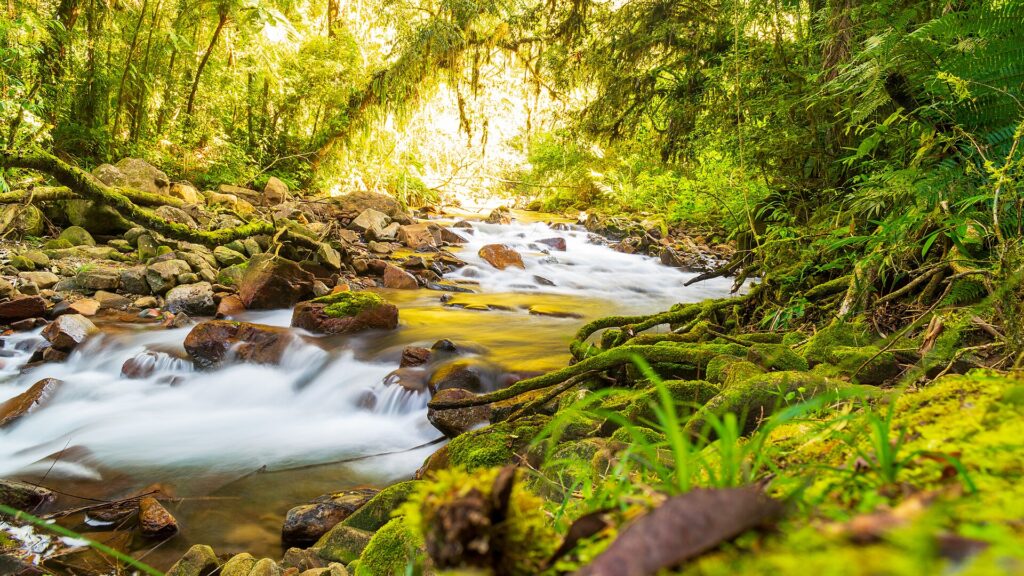
In the Vale do Ribeira, between São Paulo and Curitiba, hides Brazil’s greatest underground treasure: the PETAR (Parque Estadual Turístico do Alto Ribeira), with more than 300 catalogued caves beneath the largest continuous stretch of preserved Atlantic Forest in the country. Chambers the size of cathedrals, underground rivers and waterfalls make up a destination every ecotourist needs to live at least once.
Getting there and where to stay
The park sits in Iporanga, São Paulo state, about 330 km from São Paulo (5-6 hours) and 190 km from Curitiba. The best base is the Bairro da Serra, a hamlet 13 km from Iporanga that concentrates the guesthouses, the campsites and the entrance to the most visited sectors. The road has unpaved stretches — take it slowly, especially in the rain.
The visitor sectors
- Núcleo Santana — the best equipped, with the Santana, Morro Preto, Couto and Água Suja caves, plus trails and waterfalls on the Rio Betari.
- Núcleo Ouro Grosso — next door to Santana, with the cave of the same name and its sporting through-trip.
- Núcleo Caboclos — more remote, high in the park, with the Temimina and adventures for anyone after solitude.
- Núcleo Casa de Pedra — home to one of the largest cave portals in the world, 215 meters high.
Rules and prices
Visiting the caves requires an accredited guide (local monitors, hired in the Bairro da Serra or through the guesthouses) and an advance online booking — there is a daily visitor cap per cave. Entry costs around R$ 19 per sector, free for under-12s and over-60s. Guides charge by itinerary (R$ 150-300 per group per day, on average). We pick the best caves for each profile in which caves to visit in the PETAR — and we have put together a full 3-day itinerary.
Beyond the caves
The PETAR is also Atlantic Forest in the raw: trails between giant trees, the green waters of the Rio Betari with its waterfalls and swimming pools, blue butterflies and — for the lucky — jaguar tracks. The Bairro da Serra community, heir to generations of regionais who became environmental monitors, is part of the experience: here tourism has sustained conservation for decades.
When to go
From April to November (the dry season) the risk of a flash flood is lower and the river caves are safe. In the rainy summer many of them close — and the trails turn to mud. Whatever the season, bring a rain jacket: this is the Atlantic Forest, and it is damp by definition.
🥾 Who is it for?
Effort: moderate — the classic caves call for walking, crouching and stream crossings; there are light options and heavy ones. Children: from ages 6-7 in the easy caves (Morro Preto, Santana); the sporting ones from 12. Older travelers and people with reduced mobility: the Santana cave has walkways along much of the route and works for anyone who walks slowly; the damp, uneven floor demands care — tell your guide so the pace and the route can be adapted.