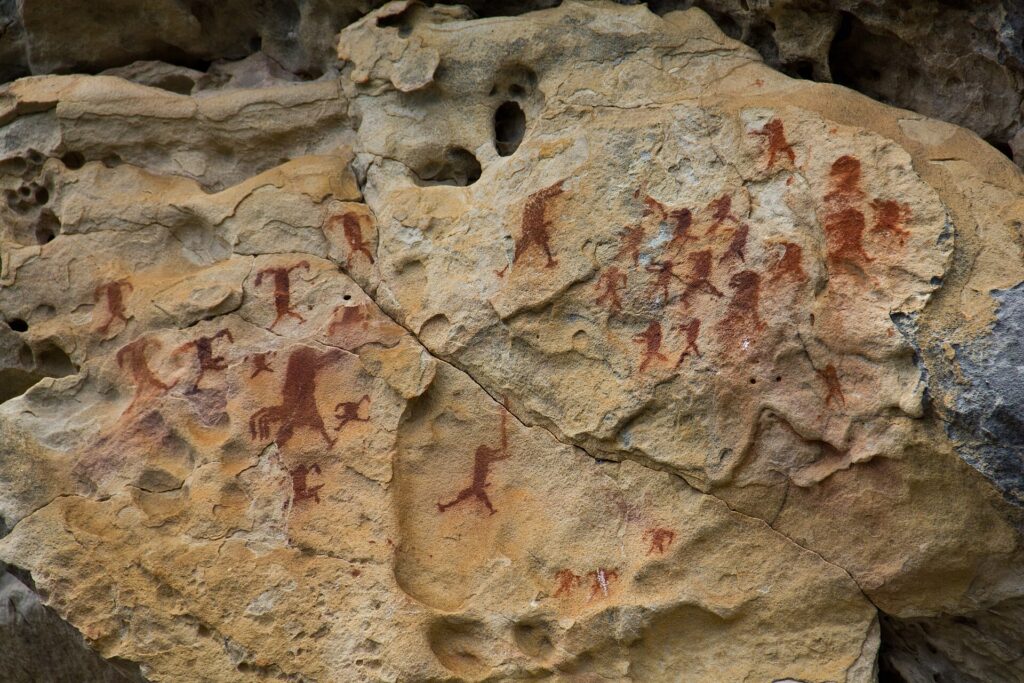
Before becoming an ecotourism destination, the Catimbau Valley was home. Beneath its sandstone walls, ancient peoples left painted records — estimated at up to six thousand years old — in red, yellow and black: hands, geometric figures, animals and scenes whose meaning still intrigues archaeologists. Visiting these sites is one of the most touching experiences of the northeastern sertão.
One of the country’s largest collections
Catimbau National Park is frequently cited as one of Brazil’s largest archaeological ensembles, alongside Serra da Capivara. Dozens of catalogued sites are scattered across the valley, many in rock shelters — natural cavities where human groups sheltered from sun and rain and where the paintings stayed preserved for millennia, away from weathering.
Where to see the paintings
Two spots concentrate the visits. Loca das Cinzas gathers panels with graphic marks and figures that seem to tell stories in sequence. Meanwhile, the Alcobaça Trail runs along the base of an imposing wall where paintings appear at every bend, including sets of hands in negative — the most human mark one can leave on a rock. Always visit with a licensed guide: that protects both the visitor and the sites.
What the drawings say
Researchers link part of the paintings to the so-called Agreste Tradition, with robust human figures and scenes of daily life, and also recognize purely geometric marks whose function — ritual, territorial, narrative — remains under debate. The most fascinating part is what is not known: each panel is a message without a translator, crossing millennia to reach our eyes.
How to visit with respect
- Never touch the paintings: skin oils degrade the pigments.
- Do not wet the panels to “bring out the colors” — an old practice that causes irreversible damage.
- Photograph without flash and keep your distance from the walls.
- Stay on the marked trails: there are still-unexcavated sites beneath your feet.
- Value the work of the local guides, everyday guardians of this heritage.
Combine it with the rest of the valley
The archaeological sites share the park with its most famous formations, like the Santuário and the Torres Lapiais, and fit into the same one- or two-day itinerary. Between July and December, the dry weather guarantees the best walking conditions — and the sunset over the painted walls is a spectacle of its own.
🥾 Who is it for?
Effort: light to moderate — the painting sites are reached by short walks with a guide. Children: from age 6-7; the hands painted thousands of years ago make for the best history lesson of their lives. Seniors and reduced mobility: some shelters have flat access — ask your guide for the reduced circuit.