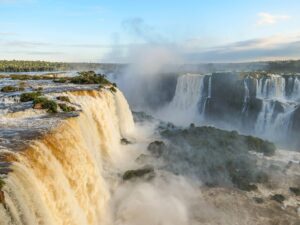
Few addresses on the planet concentrate so much water, so much forest and so much engineering: Foz do Iguaçu is the Brazilian base for the Iguazu Falls — the system of waterfalls inside Iguaçu National Park, a protected natural heritage site — and for a circuit that runs from the Itaipu dam to the meeting of the rivers at the Three Borders Landmark, where Brazil, Argentina and Paraguay touch.
Why visit
Because it is the perfect hub for anyone who wants monumental nature without giving up logistics: the whole city runs around the visit. The anchor experience is the walkway facing the Devil’s Throat — the complete experience, with access, internal transport and variations, lives on the Iguazu Falls page and in the 3-day itinerary.
Main areas and experiences
- Iguaçu National Park — the Falls from the Brazilian side: a wide panorama, a walkway trail and the mist of the Devil’s Throat (details and variations on the attraction page).
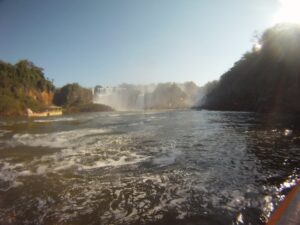
- Canyon adventure — boat rides beneath the falls, like the Macuco Safari, for those who want to feel the water up close.
- Parque das Aves and Itaipu — the forest in free flight and the scale of the binational dam (the Parque das Aves + Itaipu guide compares tickets and timings).
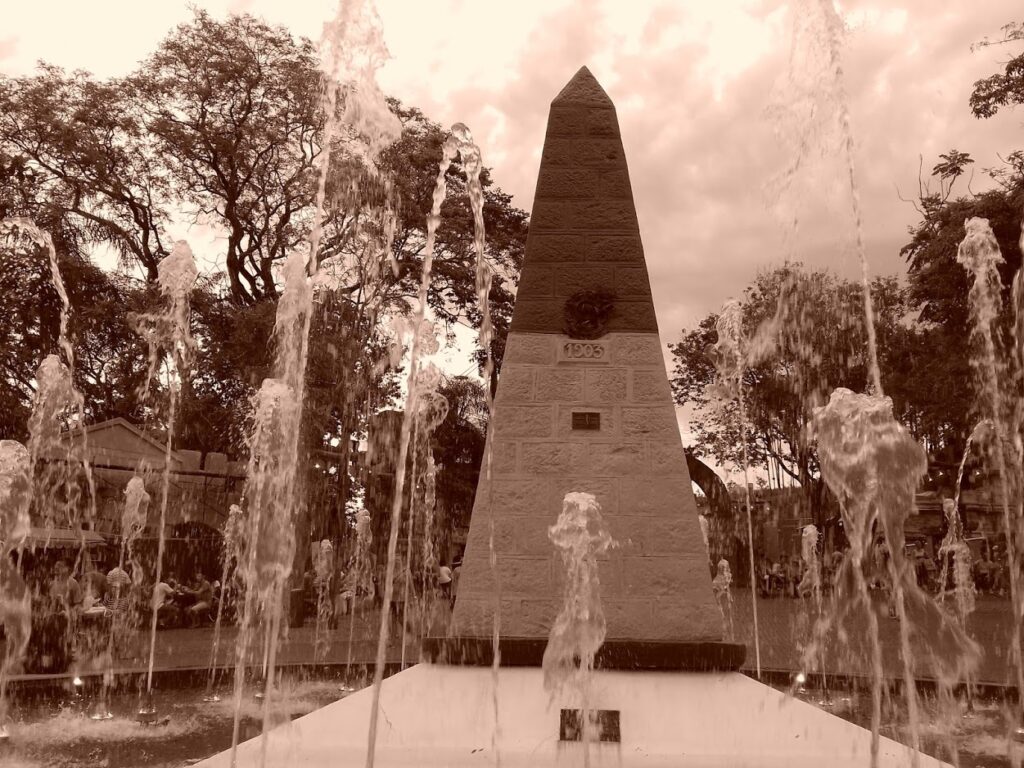
- Three Borders Landmark — the meeting of the Iguaçu and Paraná rivers, with sunsets over three countries.
- Argentine side — walkways above the Throat, in another park and another country: set aside a document and half a day.
When to go
The Falls operate year-round. From December to March, the floods swell the falls and the heat calls for early starts; from April to September, mild weather favors long walks — with the chance of a calmer river and emptier walkways on weekdays. Hours and prices change with the season: confirm on the official visitation channel and on the attraction pages.
Getting there and around
An international airport with direct flights from Brazil’s main capitals, a few kilometers from downtown and from the park entrance. Between attractions, ride-hailing apps, taxis and urban bus lines do the job — no car is needed for the classic circuit. Anyone crossing to the Argentine side or to Paraguay must carry photo ID (and check the border rules in force).
Conservation and planning
The Falls exist because the forest around them exists: the national park protects one of the last great blocks of inland Atlantic Forest — home to jaguars, caimans and toucans you will probably see. Stay on the walkways, do not feed the coatis (they know how to open backpacks) and treat the mist as rain: a light poncho and camera protection. Book tickets in advance in high season.
🥾 Who is it for?
Effort: light — walkways and internal transport do the heavy lifting; it is the adventure add-ons that raise the level. Children: all ages on the classic circuit; the boat rides have their own age rules. Seniors and people with reduced mobility: one of the most accessible major nature destinations in the country, with internal transport, walkways and a panoramic elevator — confirm the day’s conditions on the attraction page.