
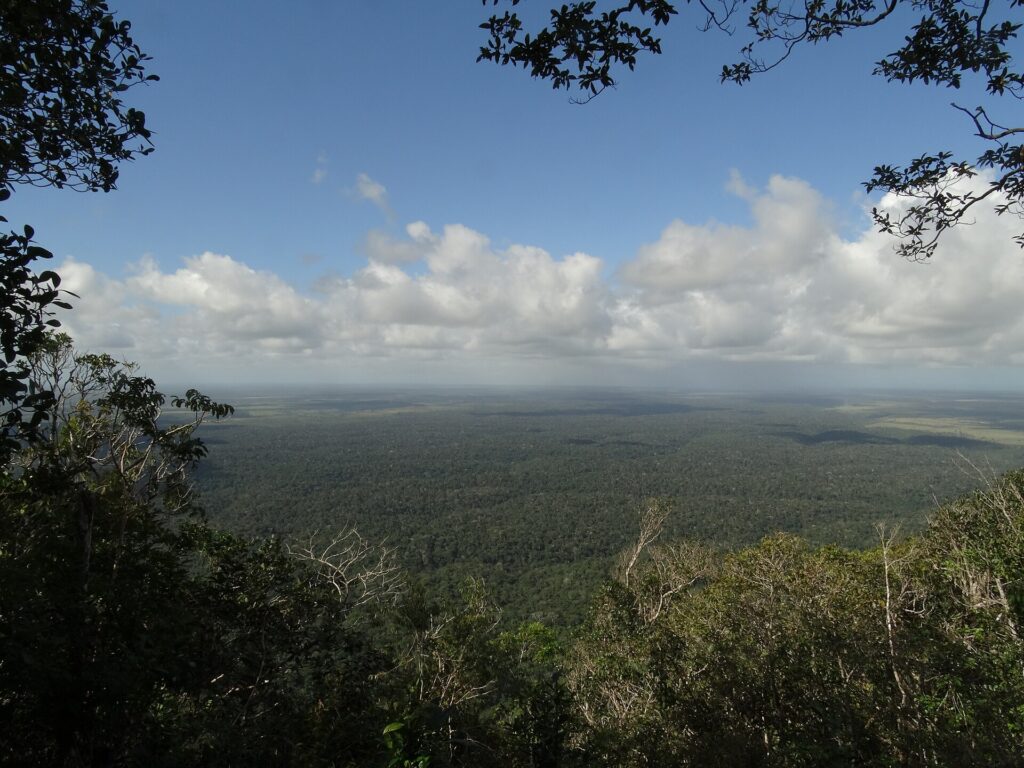
It was this forest-covered hill that the Portuguese navigators sighted in April 1500 — the first piece of Brazil seen from the sea. More than five centuries later, the Parque Nacional e Histórico do Monte Pascoal, in the far south of Bahia, tells a much older story: that of the Pataxó people, who live on these lands and today take part in managing the park, welcoming visitors for ethnotourism experiences that are among the most authentic in the country.
One park, two heritages
Created in 1961, the park protects one of the last great blocks of Atlantic Forest in the Northeast — home to jaguars, tapirs and hundreds of bird species — along with mangroves, restingas and a stretch of wild coastline. Monte Pascoal, at 536 meters, rises alone above the green plain and is visible for kilometers around.
The climb to the summit
The trail to the top leaves the village of Barra Velha and is done with Pataxó guides. The climb calls for moderate fitness: it is hours of walking inside the forest, with steep sections near the top. The reward is double — the panoramic view of the forest meeting the sea, and the stories the guides tell along the way, from medicinal plants to episodes of Indigenous resistance.
Pataxó ethno-experiences
The best reason to visit Monte Pascoal is to meet the people who live on it. The Pataxó communities offer ethno-experiences: conversation circles, body painting with natural dyes, traditional cooking such as fish in patioba (roasted in a palm leaf), songs, dances and interpretive walks. It is not a show for tourists — it is an invitation to understand the forest through the eyes of those who have defended it for generations. Book in advance directly with the village associations or through partner agencies in the region.
How to visit
The most common access is along the BR-101, via Itamaraju, to the park entrance and the village of Barra Velha — it is also possible to arrive along the coast from Caraíva, on buggy trips that cross the Indigenous territory and Ponta do Corumbau. Visits are always accompanied by local guides, and the money paid for trails and experiences stays with the communities — tourism that funds conservation and culture at the same time.
Practical tips
- Go with closed shoes, repellent, water and a willingness to walk.
- The best light for photographs of the hill is late afternoon, coming from the coast.
- Ask before photographing people and rituals — respect is part of the visit.
- Buy handicrafts directly from the Pataxó: bowls, necklaces and ceramics are souvenirs with a story.
- Combine the visit with Caraíva and Corumbau for an unforgettable 3-4 day itinerary.
🥾 Who is it for?
Effort: intense on the climb to the summit (hours of steep trail); easy for the ethno-experiences in the village. Children: cultural experiences from ages 5-6; the climb from 12-14. Older travelers and reduced mobility: the Pataxó experiences in Barra Velha are accessible and are the soul of the visit; the summit is for the prepared.