Some animals seem invented — until you get to Mamirauá. In the largest várzea reserve in the world, water that rises and falls by up to 12 meters a year has created evolutionary solutions that exist nowhere else on the planet.
The white uakari
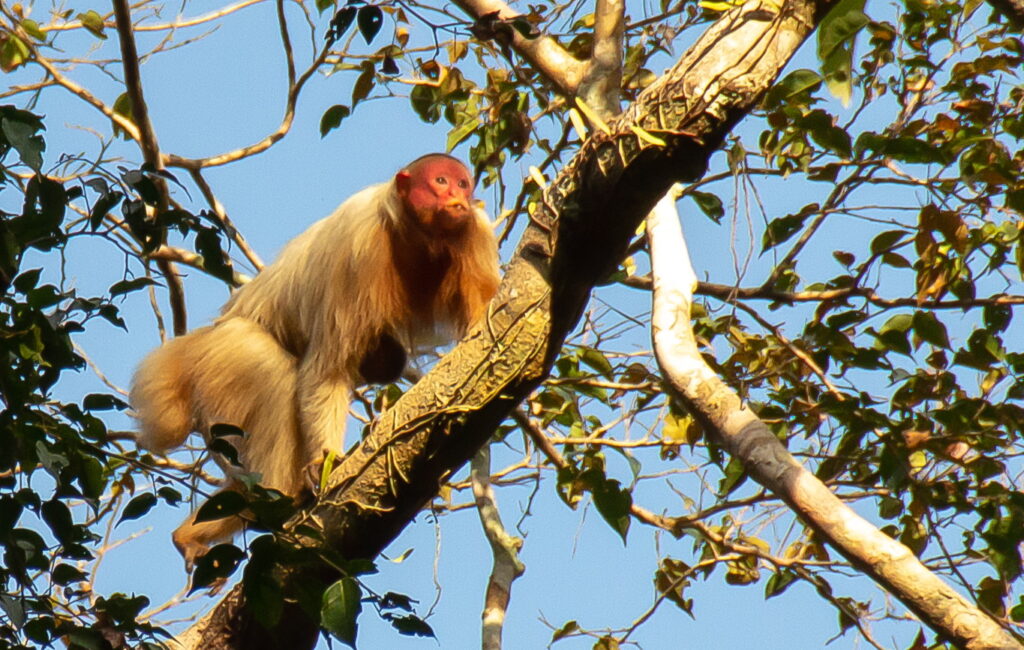
Pale, shaggy fur, a stocky body and an unmistakable bright red face: the white uakari is the symbol of Mamirauá and one of the rarest primates in the world — endemic to the várzeas of the middle Solimões, which is to say it exists in no zoo you will ever visit: either here, or nowhere. The red face, researchers say, signals health: the more intense it is, the better the animal’s condition. Seeing them leaping in troops through the canopy is the great trophy of the trip — the best chances are on the canoe outings at dawn.
Jaguars that live upstairs
When the flood covers the forest floor for months, the jaguars of Mamirauá do what no other jaguar population in the world does: they move into the trees. They hunt sloths and howler monkeys, sleep in forks and raise cubs in the canopy until the water drops. The phenomenon, documented by the Instituto Mamirauá, has become one of the most coveted scientific-tourism expeditions in the Amazon: in the right season, visitors accompany researchers monitoring the arboreal jaguars — with telemetry, silence and luck.
The supporting cast (which would be the star anywhere else)
- Pink river dolphins and tucuxis patrolling the reserve’s channels.
- Black caimans of 4+ meters — the highest density in the central Amazon.
- Pirarucus, giants that “puff” at the surface of the lakes in the dry season.
- Howler monkeys, sloths and squirrel monkeys in the trees around the floating lodge.
- Hundreds of bird species — from fishing eagles to potoos.
How to improve your chances
Wake early (the first hour of light is magic), trust the native guides — they read the forest like nobody else —, keep silent in the canoes and take individual binoculars. In the flood, the animals concentrate in the canopy and on the high restingas; in the dry season, on the lake margins. And remember: here the wildlife is 100% wild — every sighting is a gift, not an obligation.
🥾 Who is it for?
Effort: easy — observation from canoes and walkways; the scientific jaguar expeditions demand more hours and patience (moderate). Children: from the age of 10 (the lodge’s standard), ideal for teenagers with a naturalist streak. Older travelers and reduced mobility: the canoe outings are contemplative and adaptable — tell the reserve in advance; the arboreal jaguar expedition demands the mobility to board at improvised spots. For wildlife watchers, quite simply one of the best places in the world.