
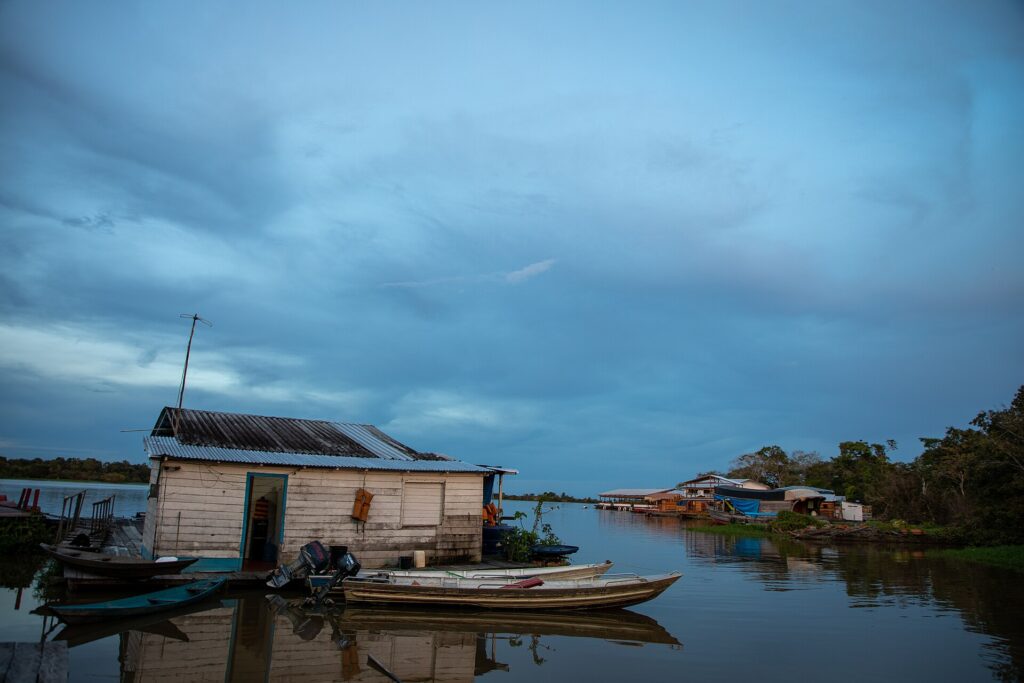
Between the Solimões and Japurá rivers, on the middle Solimões, there is a forest that spends half the year underwater — and a reserve that proved to the world that conservation and people can live together. The Mamirauá Sustainable Development Reserve is the largest protected area of flooded várzea forest on the planet, refuge of the very rare white uakari and birthplace of the most awarded community tourism model in the Amazon.
Getting there
The gateway is Tefé, reached by direct flight from Manaus (about 1h10). From there, a reserve speedboat takes roughly an hour to the Pousada Uacari (Uakari Lodge) — ten floating bungalows on an arm of a lake, built with solar power, rainwater harvesting and management shared with ten local riverside communities.
The forest that breathes with the river
In the flood (April to July), the water rises up to 12 meters and the outings are by canoe above the forest — literally among the treetops. In the dry season (September to November), trails, beaches and lakes emerge where the pirarucus teem. Each season is a different reserve; the two settings justify two trips.
Wildlife from another world
Mamirauá is the territory of the white uakari, the red-faced monkey that exists only in the várzeas of the middle Solimões, and of the only jaguars in the world that live for months up in the trees, waiting for the water to drop — a phenomenon that became a scientific expedition with visitor participation. River dolphins, black caimans, sloths, howler monkeys and a festival of birds complete the cast. We tell the details in the article on the impossible animals of Mamirauá.
How much it costs and why it is worth it
The Pousada Uacari packages (3, 4 or 7 nights) include transfers from Tefé, full board and daily outings with native guides — prices start in the range of R$ 4,000-5,000 per person for 3 nights. It is not cheap, and it is right that it is not: the income keeps the lodge running, funds research and pays wages and dividends to the communities that decided to protect the várzea. This is ecotourism in its purest state.
🥾 Who is it for?
Effort: easy to moderate — canoe and boat outings are contemplative; the dry-season trails bring mud and heat (moderate). Children: the lodge generally takes them from the age of 10 (confirm when booking) — the silent experience of observation suits older children better. Older travelers and reduced mobility: feasible in the flood, when almost everything is by canoe; the floating structures have ramps and walkways — tell the reserve about any limitations so they can adapt the itinerary. Photographers and wildlife watchers: a real risk of not wanting to leave.