
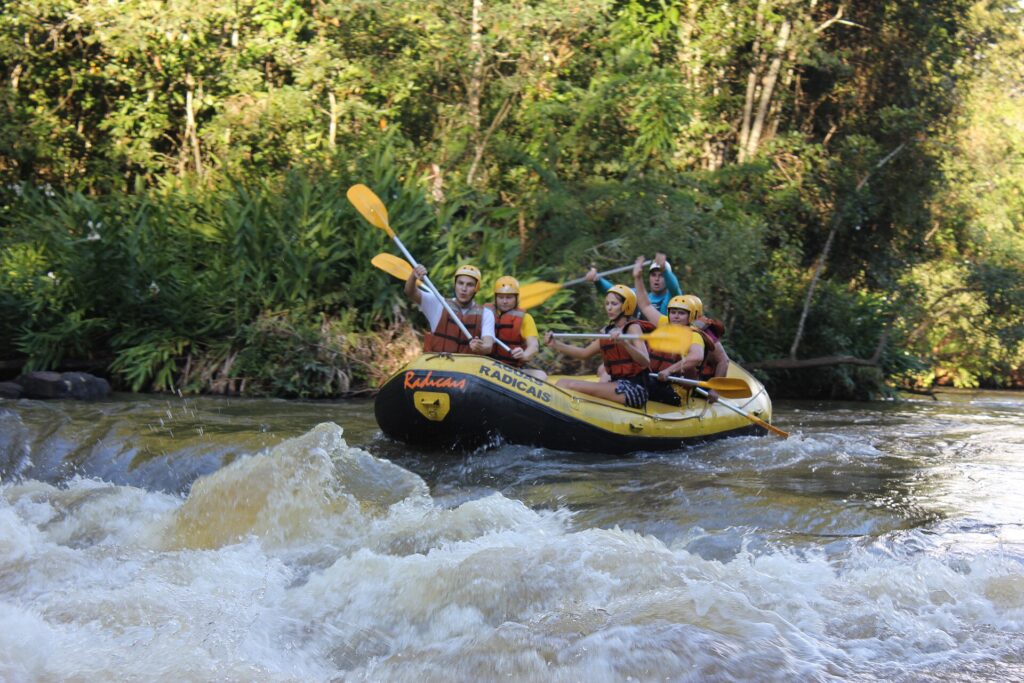
Before it was ever fashionable, Brotas was already running rapids: rafting on the Rio Jacaré-Pepira is the most traditional in Brazil, operating since the 1990s with facilities that became a benchmark. The descent crosses 14 rapids (class II-III) between sandstone walls and riverside forest — adrenaline with a São Paulo accent, on water awarded for its cleanliness.
How it works
Daily departures from the agencies in the center (~R$ 150 including transport, helmet, life jacket, paddle and a guide per raft). The run takes 40 minutes to 2 hours depending on the volume: full (December to February) it is fast and fierce; low, it is technical and playful, with stops to swim and jump off rocks. Maximum weight around 150 kg per participant and closed footwear compulsory.
The rapids
Local names set the tone: the sequence warms up gradually, the guides call for synchronised strokes (“PADDLE! PADDLE!”) and the bigger waves guarantee a collective soaking — falling out of the raft is part of the statistics (and the fun; the rescue is immediate). Photographers on the bank record it all for the photo package at the end.
Tips
- The first descent of the day = an emptier river and better light.
- Clothes you can thrash + a change in the car; sunglasses only on a strap.
- Pair it with river tubing in the afternoon to compare the two sensations.
- Torrential rain at the headwaters can cancel the trip — stay flexible.
🥾 Who is it for?
Effort: moderate — paddling in sequence and a good shaking; being able to swim is not a requirement (life jacket and guide take care of it). Children: from ages 7-8 on the standard stretches (operators confirm by river level); family stretches available. Older travelers and people with reduced mobility: active over-60s go down every day; it does require getting in and out of the raft and reacting to commands — talk to the agency. For full adaptation (wheelchair users included), neighboring Socorro runs award-winning adapted rafting — the combination of the two towns caters for literally everybody.