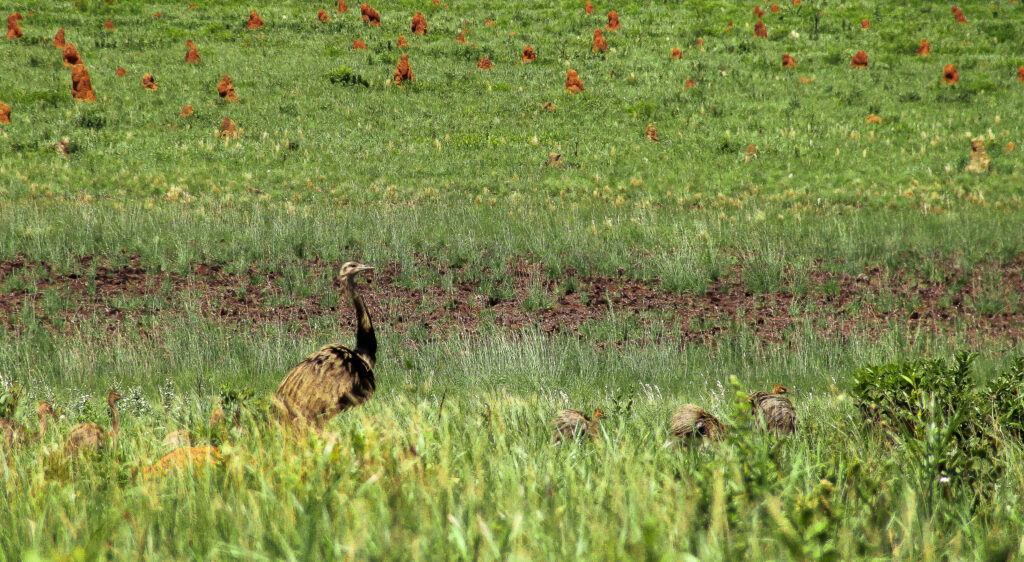
There is a corner of Goiás where the cerrado is still what it was before the crop fields: golden grassland as far as the eye can see, termite mounds in their thousands and a fauna that would fill a documentary a day. The Parque Nacional das Emas, a UNESCO Natural World Heritage Site, is called the “Brazilian Serengeti” — and it receives so few visitors that you will have all of it practically to yourself, ecotourist. This guide shows how to turn that rarity into a trip.
Where it is and how to get there
The park covers 132,000 hectares in south-western Goiás, on the border with Mato Grosso do Sul and Mato Grosso. The bases are Chapadão do Céu (the nearest gate, with a good spread of guesthouses) and Mineiros — both around 650 km from Goiânia or 430 km from Campo Grande. A car is essential; inside the park you drive your own vehicle (40 km/h maximum) or go with accredited guides.
How a visit works
Entry is free — ICMBio charges no ticket for the park. The visitor center explains the rules, and the gate is open from 8am to 5pm (closed between midday and 1pm), with no advance booking needed. Guided safaris — by car, by bike or by boat on the Rio Formoso — must be arranged in advance with the local guides (R$ 300 to R$ 500 a day per vehicle or group). The guide makes all the difference here: he is the one who knows where the maned wolf crossed that morning and which marshy hollow the giant anteater is rooting through.
The wildlife you will see
- Near guaranteed: rheas (of course!), pampas deer, seriemas, armadillos and the cathedral termite mounds that define the landscape.
- Likely: giant anteater (the park is one of the best places in the country to see one), maned wolf at dusk, macaws and caracaras.
- With luck: puma, ocelot and the very rare bush dog. Our honest assessment of the value for money is in is the Parque das Emas worth it?.
The phenomenon of the lights
From October to November the park stages one of the rarest natural spectacles on the planet: the termite mounds light up with points of green light — bioluminescent larvae hunting on the surface of the nests. Thousands of illuminated “towers” in the darkness of the cerrado. We cover it all (the season, how to see it, why it happens) in the bioluminescence of the Parque das Emas.
When to go and what it costs
| Item | Price (2026) |
|---|---|
| Park entry | ~R$ 20 |
| Guided safari (per vehicle or group, per day) | R$ 300 – R$ 500 |
| Guesthouses in Chapadão do Céu | R$ 120 – R$ 300/night |
| 3 days per person (excluding flights) | R$ 1,000 – R$ 2,000 |
Golden rules: a low speed saves animals on the dirt tracks, drones only with authorization, and never leave the tracks — the spear grass hides life (and snakes) everywhere. The raw cerrado is grateful for a respectful visit.
🥾 Who is it for?
Effort: light — vehicle safaris along the park tracks, with stops at viewpoints and termite mounds. Children: from age 6; rheas, deer and anteaters guarantee the enchantment. Older travelers and people with reduced mobility: very workable — the watching is essentially done from the car; check the optional getting-out points with your guide.
Photo: Flávio Alves, via Wikimedia Commons — CC BY-SA 4.0. Image resized; derivative under the same licence.