The Pantanal is where Brazil looks most like a wildlife documentary: the largest flooded plain on the planet, a UNESCO World Heritage site, holding the densest concentration of wildlife in the Americas. Here an ecotourist does not go looking for animals — they show up: caimans by the hundred, capybaras, hyacinth macaws, jabiru storks and, with luck and strategy, the jaguar. This guide explains how the Pantanal works, when to go, what it costs and how to choose between the North and the South.
How the Pantanal works
Forget the logic of a tourist town: in the Pantanal you stay at working ranch lodges on a full-board basis with activities included — vehicle safaris, boat trips, night spotlighting, walks and horse rides with local guides. The two gateways are Cuiabá (MT), for the North Pantanal along the Transpantaneira, and Campo Grande / Miranda (MS), for the South Pantanal along the Estrada Parque. The full comparison is in Pantanal North or South: which to choose.
When to go: the season defines the trip
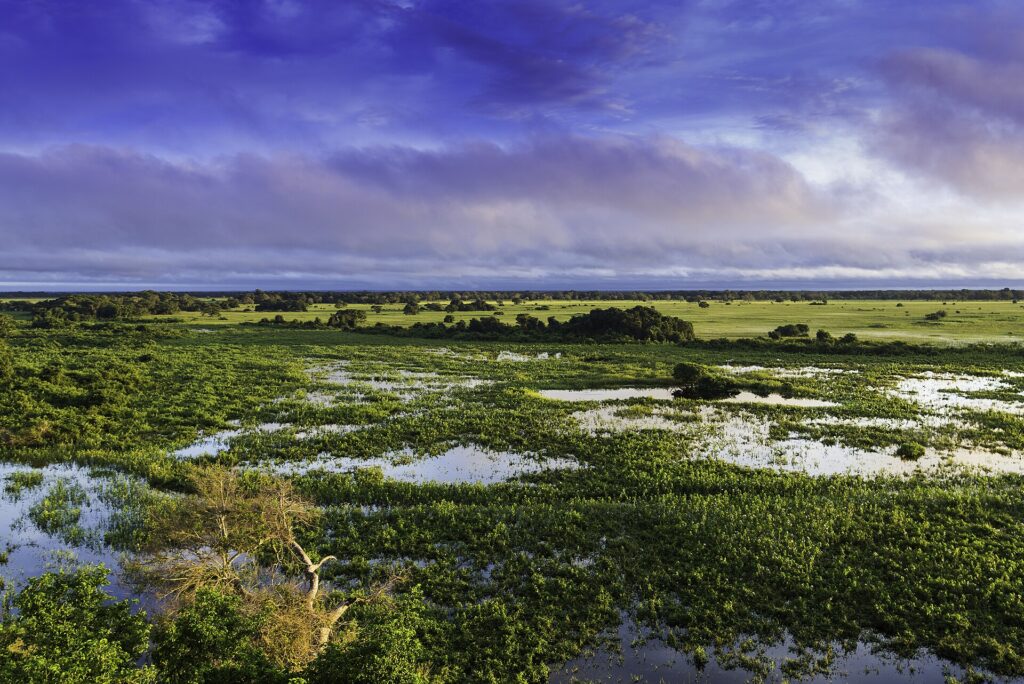
In the dry season (May to October) the water drops and wildlife concentrates along the riverbanks: this is the golden window for animal watching — and the only genuinely good one for jaguars (July to October at its peak). In the floods (November to April) the landscape becomes a spectacular inland sea, superb for birds and scenery, but part of the roads and activities close. Practical rule for an ecotourist: first time, go in the dry season.
What it costs (2026)
| Item | Estimated price |
|---|---|
| Return flight to Cuiabá or Campo Grande | R$ 800 – R$ 1,800 |
| Ranch lodge with full board and activities | R$ 600 – R$ 1,500 per person per day |
| Airport transfer (Transpantaneira / Estrada Parque) | R$ 200 – R$ 500 each way |
| Extra boat safari for jaguars (Porto Jofre) | R$ 500 – R$ 1,200 per day |
| Typical 4-day / 3-night package | R$ 3,000 – R$ 6,500 per person |
| Full jaguar photography expedition (6 days, all inclusive) | R$ 10,000 – R$ 19,000 |
What you will see (and how to see more)
- Guaranteed: caimans, capybaras, jabiru storks, pampas deer and hundreds of bird species — the Pantanal is the best birdwatching in Brazil.
- Likely: giant otters in family groups, giant anteaters, marsh deer, capuchin monkeys.
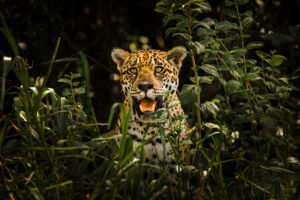
- The prize: the jaguar — the Pantanal holds the highest density in the world and sighting rates that reach 95% in the right season. The full strategy is in where to see jaguars in the Pantanal.
- Start early: the wildlife works from 5.30am to 9am and comes back late in the afternoon. The middle of the day is for the pool and the hammock — respect the Pantanal siesta.
Ecotourism that keeps the Pantanal standing
Every night at a ranch lodge is a vote for conservation: properties that live off tourism keep the biome intact and protect jaguars instead of hunting them — the logic that projects such as Onçafari have proved works. Choose lodges with local guides, do not feed the animals, keep your distance (that is what the zoom is for) and never ask the boatman to get closer to a jaguar: the animal stressed today is the one nobody sees tomorrow.
Combining the trip: Bonito is about 300 km from Campo Grande and forms, with the South Pantanal, the perfect one-week pairing in Mato Grosso do Sul.
🥾 Who is it for?
Effort: light — vehicle safaris, boat trips and easy horse rides; the Pantanal reveals itself without demanding legs. Children: excellent from age 6; guaranteed animals keep any child glued to the binoculars. Older travelers and people with reduced mobility: very workable — most lodges run car and boat safaris with simple boarding; confirm ramps and ground-floor rooms when booking.