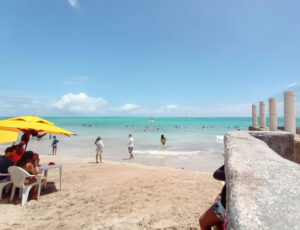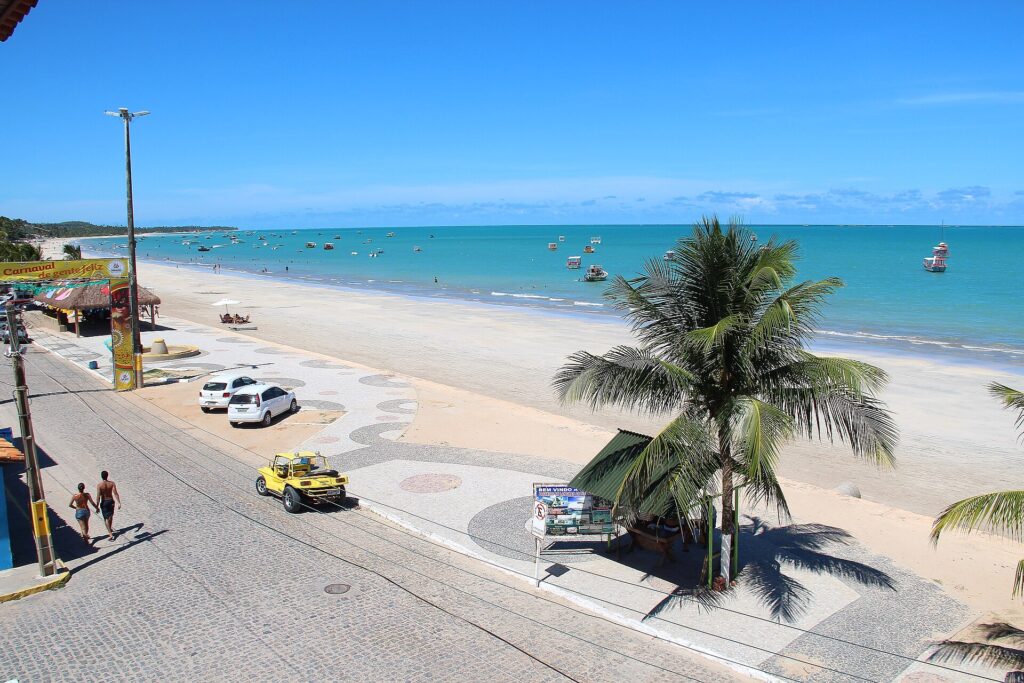
There is a reason Maragogi earned the nickname Brazilian Caribbean: at low tide the sea pulls back and reveals turquoise pools over coral reefs kilometers from the shore. The most famous of those reefs, the Galés, has become a synonym for the destination — and all of it sits inside the Costa dos Corais Environmental Protection Area, the largest coastal marine conservation unit in Brazil.
Where it is and how to get there
Maragogi is on the northern coast of Alagoas, about 125 km from Maceió and 130 km from Recife — either airport serves equally well, and the drive along the coastal road is an outing in itself, with coconut groves and viewpoints along the way. Transfers and rental cars both solve the journey.
The natural pools
The municipality has four main areas of natural pools. The Galés, about 3.5 km offshore, are the most famous: crystal-clear water, colorful shoals and a proper snorkeling set-up. The Taocas lie in front of the town center; Barra Grande, just 2 km from the beach of the same name, is the closest to the mainland; and the Croa de São Bento combines pools with a sandbank that emerges at low tide.
How the tour works
The tours leave from the central beach and from Barra Grande on catamarans, schooners or speedboats, last around 3 hours and only run at low tide — which is why the times change every day. We explain the detail, the prices and how to read the tide table in how the Galés tour works.
A sanctuary that needs you
The Costa dos Corais protected area covers more than 400,000 hectares of reefs, mangroves and seagrass beds between Alagoas and Pernambuco — a refuge for sea turtles and for the endangered Antillean manatee. In the pools, the rules exist to keep the spectacle alive: do not stand on or touch the coral, do not feed the fish, use only reef-safe sunscreen (or a UV shirt) and always follow your guide’s instructions.
Beyond the pools
On the driest tides the sea opens paths of sand and reef such as the famous “Caminho de Moisés” (Moses’ Path), which produces surreal photographs. The beaches of Antunes and Burgalhau, with coconut palms leaning over pale sand, complete the itinerary — and anyone who carries on 30 minutes south reaches São Miguel dos Milagres, another lovely stretch of the Alagoas Rota Ecológica.
When to go
The water is warm all year, averaging 25 °C. October to January combines clear skies with transparent sea; May and June concentrate the rain and are worth avoiding. In any season, the right day is a low tide with a small coefficient — it is worth building the trip around the tide table.
🥾 Who is it for?
Effort: light — a catamaran out to the pools and snorkeling in a life jacket. Children: all ages (babies are better off on land); in the shallow pools the little ones can stand. Older travelers and people with reduced mobility: one of the most accessible sea outings in Brazil — ramp boarding, a short ladder on the catamaran and a life jacket; tell the operator if you need extra support.