
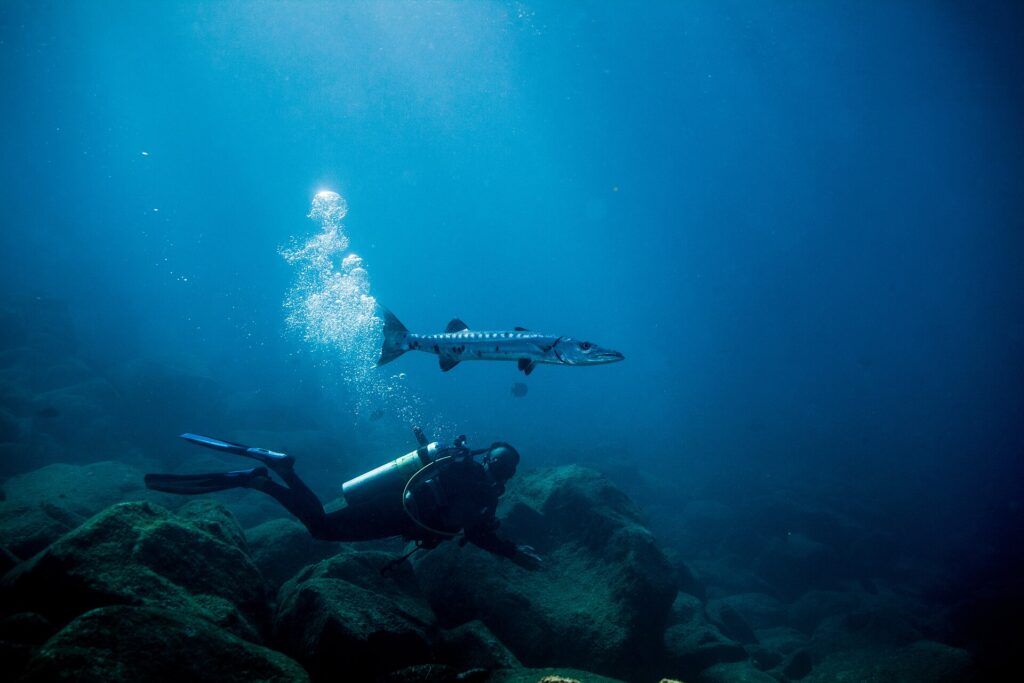
If Noronha is the best diving in Brazil, this is the page that turns that into a plan: here you, ecotourist, will find the three levels of the experience — from free snorkeling to a tank dive at the classic sites — with 2026 prices, where to book and the rules that protect what makes this sea worth the trip. The general context of the archipelago (fees, arrival, beaches) is in the complete Fernando de Noronha guide.
Why the sea at Noronha is so special
The archipelago is the top of a volcanic mountain rising 4,000 m from the floor of the Atlantic. Far from any river mouth, the water takes in no sediment — the result is average visibility of 30 m, reaching 50 m between September and October. Add the protection of the Marine National Park since 1988 and you get a rare density of life: green and hawksbill turtles, nurse and reef sharks, manta rays, octopus, moray eels and shoals that blot out the sun.
Level 1 — Snorkeling: the entry-level aquarium (almost free)
Hire a mask and fins for about R$ 30 a day and head to Praia do Porto: in shallow water there are two wrecks covered in coral, turtles and rays — many ecotourists see more wildlife there than on paid dives elsewhere. At Sueste, the float is guided and compulsory with a life jacket (around R$ 50), swimming alongside grazing turtles. Golden rule: hands behind your back, respectful distance, no touching.
Level 2 — First dive: your first tank
Never dived? Noronha is the best place in the country to start. A first dive costs R$ 500 to R$ 900 (with a one-to-one instructor, briefing and equipment) and goes down 8-12 m at calm sites. It needs no course and no experience — only listening carefully to the briefing. Underwater photos usually cost an extra R$ 150.
Level 3 — Certified: the classic sites
For certified divers, ICMBio-accredited operators go out daily to sites such as Laje Dois Irmãos, Cabeço da Sapata and the wreck of the tug Ipiranga (at 60 m, for technical divers). A two-dive outing costs around R$ 1,000. From August to November the sea is a mirror; from December to March the swell can close sites on the sheltered side — check the best month for your profile in the best time for Noronha.
What diving in Noronha costs
| Experience | Price (2026) | Who it is for |
|---|---|---|
| Snorkel kit (hire per day) | R$ 30 | Everyone — the Porto on your own |
| Guided float at Sueste | ~R$ 50 | Everyone — turtles guaranteed |
| Sub-plane (towed board) | ~R$ 150 | Anyone who wants to cover a lot of ground without a tank |
| First dive | R$ 500 – R$ 900 | Beginners with no certification |
| Accredited outing (2 tanks) | ~R$ 1,000 | Certified divers |
Diving that conserves
- Keep your buoyancy sharp: one kick of a fin into coral undoes decades of growth.
- Mineral sunscreen or a UV shirt — chemical filters bleach coral and are banned at some sites on the island.
- No gloves: if you cannot touch it, you do not need them.
- Choose accredited operators — the ICMBio seal is your filter for quality and ethics.
Planning the full budget for the trip? The line-by-line account is in what Fernando de Noronha costs.
🥾 Who is it for?
Effort: moderate — a first dive needs no experience, but it does ask for comfort in the water. Children: a first dive is generally from ages 10-12, depending on the operator. Older travelers and people with reduced mobility: no age limit with a medical certificate; snorkeling is the light alternative that already shows the spectacle.