
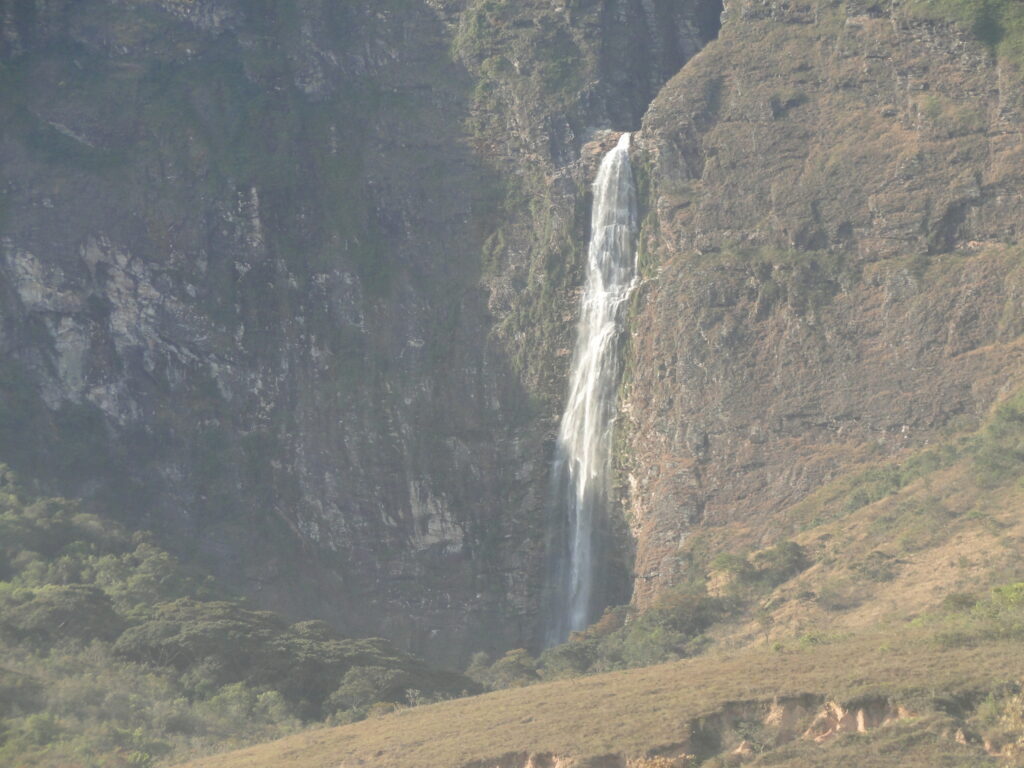
The São Francisco River is only a few kilometers old when it meets the rim of the Serra da Canastra plateau — and throws itself off. Casca d’Anta is the Velho Chico’s first great waterfall: 186 meters of thundering water curtain against the rock wall, rainbows in the mist and an icy pool at the base. It is the park’s most powerful sight, the kind that silences the whole group.
Why visit
No other waterfall carries this biography: it is the river of national integration in free fall, on the first step of its ~2,800 km to the sea. The visit splits into two complementary viewpoints — from below, at the base pool, the scale crushes you; from above, at the upper-section viewpoints, the valley opens to the horizon. If you can, do both — the Casca d’Anta + Source epic day guide organizes the route.
Access and logistics
- Lower section (the base pool) — São José do Barreiro gate (Vargem Bonita); a forest trail of ~40-60 minutes, climbing over rocks and roots.
- Upper section (the top viewpoints) — through the São Roque de Minas gate, arriving by car close to the rim; ~2h of dirt road separate the two gates — the trail linking the upper and lower sections is temporarily closed (Geological Survey of Brazil recommendation); the connection is by road.
- Park gates — open 8am to 6pm, with entry until 4pm (ICMBio Operational Protocol No. 01/2026); the entrance fee is momentarily suspended, except at the Paraíso Complex in Delfinópolis — confirm the current rules before you go.
- Guides — not mandatory for any park activity (ICMBio); recommended by park management itself given the natural-environment risks.
- Facilities — there are no services inside the park: full tank, water and snacks on board.
What to expect from the visit
At the base, the trail climbs through forest to the waterfall’s amphitheater: spray on your face, an icy swim for the brave and slippery rocks at the pool’s edge. At the top, the São Francisco simply vanishes off the plateau — the unfenced viewpoints demand respectful distance from the rim. In late afternoon the light gilds the entire wall; in the morning, a rainbow forms in the mist at the base.
When to go and precautions
In the dry season (April to September), roads are firm, the trail is safe and the water runs clear; in the wet season (December to March), the falls double in fury, but the dirt roads punish and the pool turns rough. The waterfall sits inside a national park created in 1972 to protect the São Francisco’s springs: stay on marked trails, take nothing but photos and check conditions at the gate — and swim only where signs allow.
🥾 Who is it for?
Effort: light at the upper viewpoints; moderate on the base trail (a climb over rocks and roots). Children: the base from age 6-7 with stamina; the top viewpoints, for all ages. Seniors and people with reduced mobility: the upper viewpoints are reachable by car with minimal walking; the base trail asks for good knees — trekking poles help a lot on the descent. Complete the day at the historic source of the São Francisco, nearby via the upper section.