
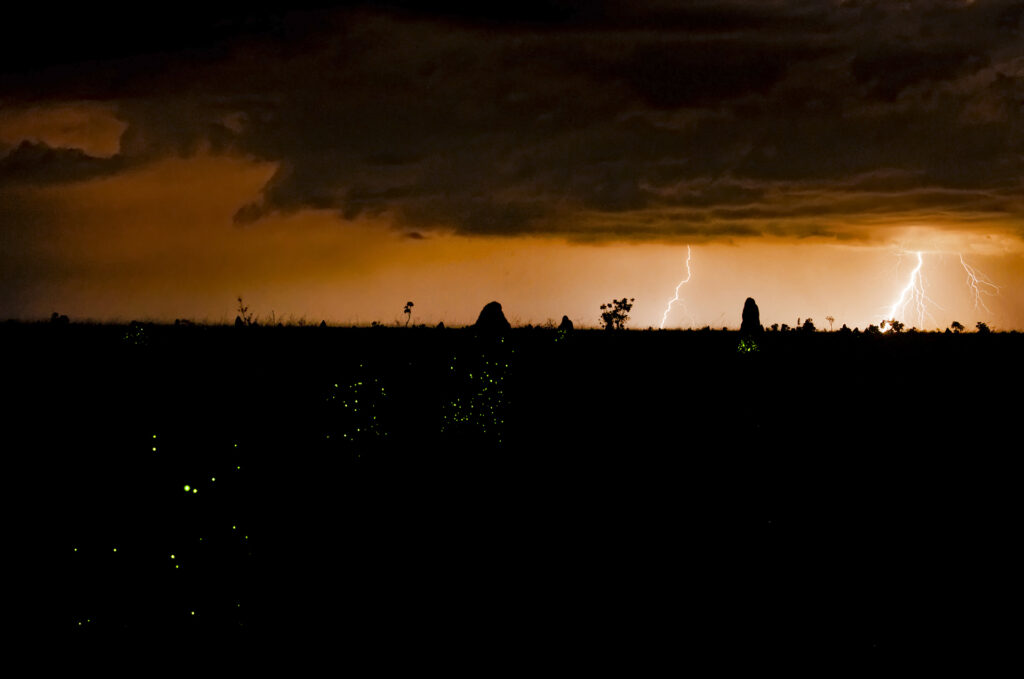
Picture the cerrado at night, in total darkness, and suddenly thousands of earthen towers lit up with points of greenish light — like miniature cities scattered across the grassland. It is neither legend nor Photoshop: it is the bioluminescence of the termite mounds, a phenomenon that makes the Parque Nacional das Emas a global bucket-list destination and that very few Brazilians know about. Here is the full guide to witnessing it — the context of the park is in the Parque das Emas guide.
What makes the termite mounds glow
The lights are the larvae of the click beetle Pyrearinus termitilluminans, which live in the outer tunnels of the mounds. At the start of the rainy season they position themselves at the “windows” of the nests and switch on their chemical light to attract their prey: the winged termites and ants that swarm after the first rains. Each green point is a luminous trap — pure biology putting on a show. It is environmental education in its most hypnotic form: the ecotourist watches a food chain happening in neon.
When and how to see it
- The right window: October and November, in the first weeks after the rains begin — warm, humid nights with NO strong moon are the best.
- Only with an accredited guide: the night outings are booked with the park guides (R$ 300-500 per group) — and they are worth every centavo, because they know which fields have the highest concentration of active mounds.
- Red light, low voices: a white flashlight “switches off” the phenomenon for everyone — the guides explain the protocol.
- Photography: tripod plus long exposure (15-30s, high ISO). Go with battery to spare and calibrated expectations: the photograph never does justice to being there.
Build the trip around the phenomenon
The bioluminescence is nocturnal — which leaves the days free for wildlife safaris: anteaters, rheas and, with luck, the maned wolf (see what to expect from each day in the park). Three nights in Chapadão do Céu at the end of October is the perfect plan: two attempts at the lights (the phenomenon varies from night to night) plus two days of safari. And a bonus of the season: the cerrado sky, free of light pollution, is a natural planetarium even when the termite mounds are resting.
A word from one ecotourist to another: October and November are the season of rain and lightning in the cerrado — outings can be rescheduled for safety. Go with a spare day in the itinerary and nature pays you back.
🥾 Who is it for?
Effort: light — the bioluminescence of the termite mounds is watched standing still, at night, close to the vehicle. Children: magical at any age that can stay up late; bring a jacket. Older travelers and people with reduced mobility: the spectacle happens a few steps from the car — minimal effort. Wheelchair users: the observation point is on natural cerrado ground; check the conditions and the support available with the agency.